Vinyl Plank Flooring Installation in Thornhill
You want a floor that shrugs off water in a Thornhill basement, kitchen or bathroom, and click vinyl plank is the one we fit for that within our flooring services.
We install click vinyl plank across Thornhill, in basements, kitchens, entries, bathrooms and condo suites. The planks themselves are waterproof, lock together without glue and cut with a knife. The work is mostly in the preparation: a smooth, flat, dry subfloor, the correct underlay or none, and room for the floor to expand.
On this page
- Rigid core versus flexible plank
- What waterproof does and does not mean
- Going over tile, concrete and old sheet flooring
- Heat, sun and the other things that damage vinyl
Get a quote for this job
Rigid core or flexible plank: what is the difference?
Most click vinyl sold now is rigid core. The plank has a stiff centre, often a stone and plastic composite, with a printed layer and a clear wear layer on top. It clicks together and floats.
Flexible vinyl plank is thinner and bends in your hand. It is glued down or laid loose, and it copies every ridge and screw head beneath it.
Two numbers matter on the box. Overall thickness affects how the floor feels and how it meets the next room. The wear layer, given in mil (thousandths of an inch), is what stands between shoes and the printed pattern: 12 mil is common for a house, 20 mil for heavier use. A thick plank with a thin wear layer still wears through early.
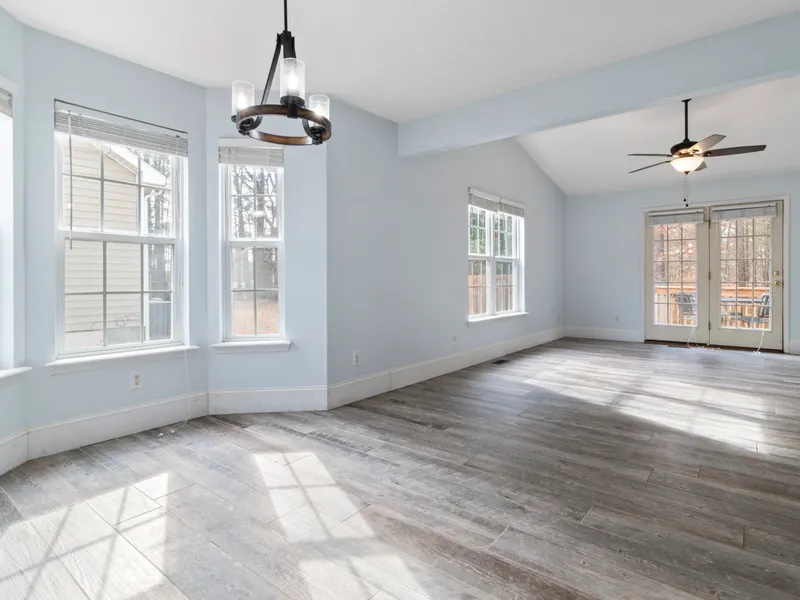
Is vinyl plank really waterproof?
The plank is. Soak one in a bucket and nothing happens to it. The floor as a system is another matter: water can run through the joints or around the edges and sit on the subfloor, where it cannot dry.
On a basement slab, that trapped moisture is what leads to a musty smell and mould under an otherwise perfect floor. So the slab is still tested, and a basement that takes in water still needs that solved first.
In a bathroom, the gap around the room is filled with flexible silicone, not left open, so a splash or an overflow stays on top. The toilet has to come off for the planks to run under its base.
Can vinyl plank go over existing tile or old sheet flooring?
Over ceramic tile, often yes. The tile has to be solid, with no loose or hollow pieces. Narrow, shallow grout lines disappear under a rigid plank; wide or deep ones are skimmed flush with a patching compound first, or the grid shows through in time.
Over bare concrete, ridges and trowel marks are ground off and holes filled. A grain of sand under vinyl becomes a bump you can see in low light.
Sheet vinyl is a common find under later floors in Thornhill houses from the 1960s to the 1980s. A single flat, firmly glued layer can stay as the base. Cushioned or loose sheet goes, since click joints flex over anything soft.
Sheet flooring and adhesive from those decades may contain asbestos. It is left undisturbed, or sampled and lab tested before removal. It is never sanded.
What goes wrong with vinyl plank?
- Heat and sun. Vinyl grows when it gets hot. In front of a south-facing patio door, planks can swell, lift or pull apart at the ends. Blinds help, and so does choosing a product rated for sunny rooms.
- Broken click edges. The locking tongue on a rigid plank is thin. Over a dip in the subfloor it flexes with each step until it snaps, and the joint opens.
- A pinned floor. Like any floating floor it needs its gap at walls and door frames, and cabinets must not sit on it.
- The wrong underlay. Many planks come with a pad attached, and adding a second soft layer under them is commonly not allowed by the maker.
The underlay point matters in Thornhill's condo towers. If your building requires a particular underlay for sound, choose a plank whose instructions permit it, and settle that with the property manager before the order goes in.
How is the floor cut and fitted?
Straight cuts are scored with a sharp utility knife along a square and snapped. Notches around door frames and vents are cut with a fine saw or shears. It is quiet, nearly dust-free work, which suits a condo with limited work hours.
The planks should be at room temperature before they are clicked together. Vinyl brought in cold from a garage in January is brittle, and it will grow once it warms up on the floor.
Rows are staggered so end joints never line up, pattern repeats are spread out so two identical planks do not sit side by side, and the last row is planned so it is not a thin strip.
Vinyl Plank Flooring questions
Can vinyl plank run through a whole basement without a break?
Each product sets a maximum run. Past that, a T-moulding at a doorway splits the floor into sections.
Does vinyl plank need time to acclimate?
Many rigid-core products need little or none, but they do need to be installed at normal room temperature. The box instructions decide.
Can it go on basement stairs?
Stair treads are glued down with a matching nosing, not floated.
Can vinyl plank go in a kitchen I am not renovating?
Yes. It is fitted up to the cabinet toe kicks with a gap, and the gap is covered with quarter round or a matching trim.
Tell us the room and what's on the floor now
Send photos of the existing floor and any doorways through the quote form, with the room measurements and the plank you have in mind.