Drywall Contractor in Thornhill for Small Jobs
You're looking for a drywall contractor in Thornhill who'll take a patch, a few nail pops or one small wall, the jobs the big outfits turn down.
Yes. We do small drywall work across Thornhill: patching holes and cracks, fixing nail pops and damaged corners, closing up walls after a plumber or electrician, hanging and taping small areas of new board, and removing popcorn ceilings that a lab has tested clear of asbestos. Everything is finished smooth and primed, ready for paint.
On this page
- Which drywall page fits your job
- Nail pops and why they return
- Dented corners and corner bead
- Closing a wall after a plumber or electrician
- Why drywall takes more than one visit
Get a quote for this job
Drywall jobs with their own page
Drywall Repair
Holes, cracks and water-damaged board cut out, patched, taped and sanded flush with the wall.
See detailsDrywall Installation
New board hung, taped and finished on a basement wall, closet, bulkhead or ceiling section.
See detailsPopcorn Ceiling Removal
Textured ceilings lab tested first, then scraped, skim coated, primed and painted smooth.
See detailsWhich drywall job is yours?
- A hole, a crack or water damage in an existing wall or ceiling: see drywall repair.
- New board on bare framing, such as a basement wall, a closet or a bulkhead: see drywall installation.
- A textured ceiling you want smooth: see popcorn ceiling removal, and read the asbestos testing section before anything else.
Why do nail pops keep coming back?
A nail pop is a small round bump or crescent crack where a fastener has pushed the compound off. Houses built here from the 1960s to the 1980s were often hung with nails, and as the studs dried and moved with the seasons, the nails worked loose.
Filling over the bump fails because the board is still loose at that spot. The fix is to drive a drywall screw into the stud about an inch or two above and below the pop, pulling the board tight. The old nail is then pulled or set below the surface, and all three dimples get compound.
Can a dented outside corner be fixed?
Yes. Outside corners are protected by a metal or vinyl strip called corner bead, buried in compound. A hard knock from furniture dents the metal or cracks the compound along its edge.
A shallow dent is filled and reshaped. A bead that's bent, rusted or loose gets cut out for its damaged length and a new piece fastened in, then coated on both sides and sanded to a straight line.
Who closes the wall after a plumber or electrician?
Often nobody, unless you arrange it. Trades cut the access they need and leave the hole. We close it once their work is finished and, where an inspection applies, passed.
The clean way is to square up the opening, screw wood backing behind the edges, fit a new piece of board the same thickness, tape and finish. Where a plumber may need to get back in, such as behind a tub's taps, a paintable access panel is a sensible alternative to a patch.
We close walls. We don't do what's inside them. Wiring is for an ESA Licensed Electrical Contractor, and supply or drain lines are a plumber's job.
Taping, and why it takes several visits
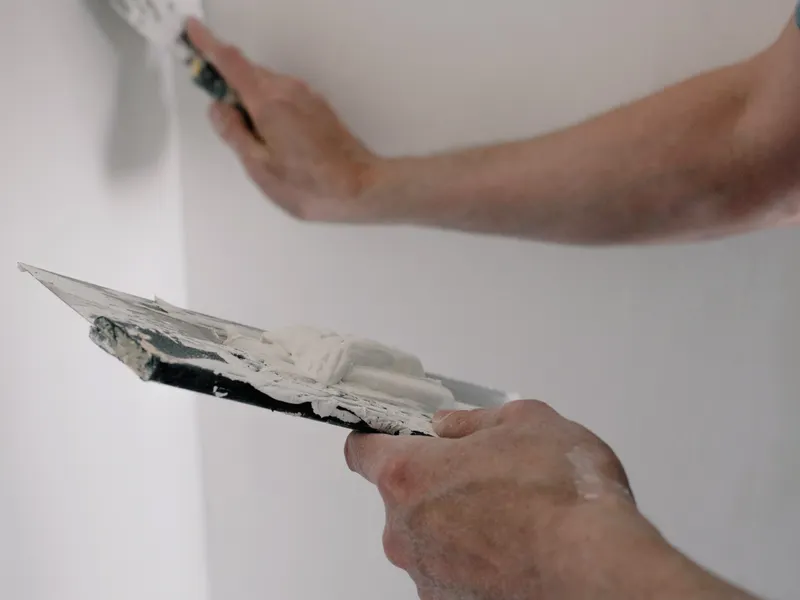
If someone has hung board and stopped, we tape and finish it. Joints get paper tape bedded in compound, then two more coats, each wider than the last, with screw heads coated three times.
Premixed compound needs roughly 24 hours a coat to dry, longer in a cool basement. Powdered setting compound hardens in 20 to 90 minutes depending on the type, which lets small repairs get two coats in a visit, but the final skim and sanding still come later.
Then primer. Unprimed compound drinks paint and shows as a dull band under any finish, so nothing we do is left bare.
Drywall questions
Do you paint the repair afterwards?
We can prime and paint it. A fresh patch of paint in the middle of a wall usually shows, so plan on painting that wall corner to corner.
Can you work on plaster walls?
Yes. The older village houses have plaster, and cracks and loose areas there are repaired with tape and setting compound or cut out and replaced with board.
How dusty is sanding?
Fine white dust travels. We close the room off with plastic, cover floor vents and use a vacuum sander or damp sponge sanding where the job allows.
Do you take down walls?
A wall that carries load is not handyman work. It can need a building permit and an engineer, and the permit comes from Vaughan or Markham depending on your side of Yonge Street.
Show us the damage
Send a photo with something for scale, a hand or a tape measure, and say which room it's in. The quote form takes several photos at once.