TV Mounting in Thornhill
You bought a TV, maybe a mount too, and you want it on the wall of your Thornhill home without guessing what the screws are biting into.
Yes, we mount TVs across Thornhill as part of our wall mounting work. We find the framing, match the fastener to the wall, set the height to your seating, level the bracket and hang the set. Wood studs take lag bolts. Steel studs and concrete, common in condos, need different anchors.
On this page
- What holds a TV on wood studs, steel studs and concrete
- The height most people get wrong
- Mounting above a fireplace
- Hiding cables without breaking electrical rules
- Choosing a fixed, tilting or full-motion mount
Get a quote for this job
What holds a TV on each kind of wall?
- Wood studs. Standard in Thornhill houses from the 1960s through to Thornhill Woods. Studs usually sit 16 inches apart, so a bracket catches two. We drill a pilot hole in the centre of each stud and drive 5/16 inch lag bolts. A lag near the edge of a stud splits it and holds almost nothing.
- Steel studs. Found in condo partition walls. The stud is thin folded sheet metal, and a lag bolt strips it out. We use toggle anchors that pass through the drywall and the stud face and clamp behind the steel.
- Concrete. Condo party walls. Holes are hammer-drilled to the anchor's exact depth, blown clean, then fitted with sleeve anchors or concrete screws. Dust left in the hole is the usual reason a concrete screw spins.
- Plaster. In older houses we drill slowly, without hammer action, and fasten into the framing behind. The plaster carries none of the weight.
The lag bolts packed with a mount are sized for wood studs only. On any other wall they stay in the box.
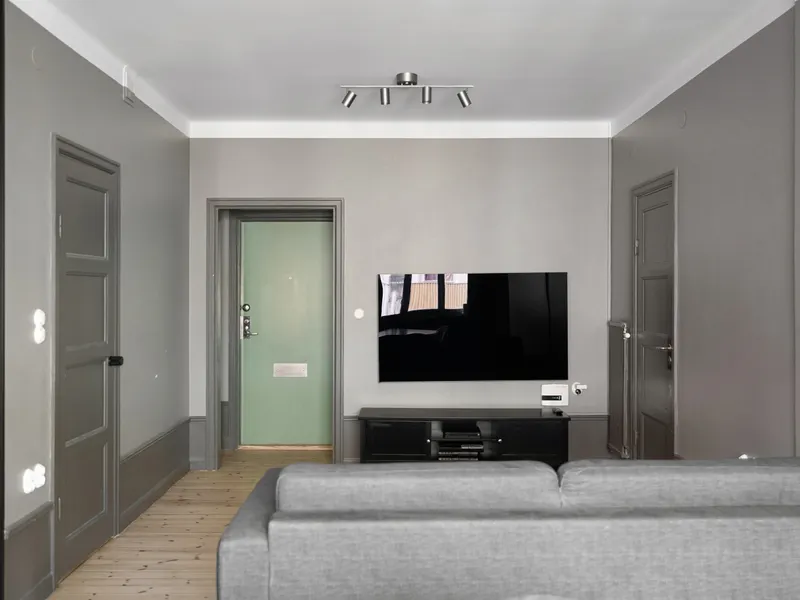
Can a TV go on a condo wall?
Yes, with the right mount for the wall. A fixed or tilting bracket on steel studs works well with toggles, because the load pushes mostly straight down.
A full-motion arm is different. With a 65-inch set pulled out on the arm, the pull on the top fasteners multiplies. On steel studs we first fasten a plywood backer across several studs, or we recommend a concrete wall instead.
Before the visit, ask your property manager about work hours and whether drilling into concrete is allowed in your building.
How high should the TV go?
Lower than you think. The middle of the screen belongs near your eye level when seated, which for a typical sofa puts the screen centre about 42 inches off the floor.
We tape the TV's outline on the wall and have you sit down and look at it before drilling. The bracket holes on the back of a TV are rarely centred top to bottom, so we measure from those holes to the top edge of the set, not from the middle.
Can it go above a fireplace?
Two problems come with that spot: heat and neck angle.
A simple test settles the heat question. Tape a thermometer to the wall where the TV would sit and run the fireplace for an hour. If the wall gets hotter than the TV maker's stated operating limit, the set does not belong there. A mantel helps by deflecting rising heat.
On brick or stone, anchors go into solid masonry, never into a crumbling mortar joint.
We do not touch the fireplace itself. Any work on a gas fireplace or its gas line belongs to a TSSA-registered contractor.
What happens to the cables?
There are three honest options:
- A paintable cord cover on the wall surface. Quick, and no holes in the wall beyond small screws or adhesive.
- HDMI and other low-voltage cables rated for in-wall use, fished down the stud bay between two brush plates.
- A recessed outlet behind the TV, so no power cord shows at all.
The TV's own power cord can't be run inside the wall, and installing a new outlet behind the set is electrical work. In Ontario that needs an ESA Licensed Electrical Contractor. We can mount the TV before or after their visit.
Fixed, tilting or full-motion: which mount?
Fixed sits closest to the wall and suits a TV at eye level straight across from the seating. Tilting suits a higher position or a window that throws glare. Full-motion suits a corner, or a room where the TV is watched from the kitchen as well as the sofa.
Check two numbers on the mount's box against the TV's manual: the VESA hole pattern and the weight rating.
TV Mounting questions
Is drywall alone ever enough for a TV?
No. Drywall is gypsum between two sheets of paper. Every TV we hang is fastened to framing, to concrete, or to a backer that is.
Can you mount a TV that has been on its stand?
Yes. The feet unscrew, and you should keep them. The bolts for the back of the set need the right length: too long and they bottom out inside the TV.
How big a TV can you hang?
Large sets are a two-person lift onto the bracket.
Tell us the TV size and the wall it is going on
Send the screen size, the mount type if you have one, and a photo of the wall through the quote form. Mention if it is a condo so we bring anchors for steel studs and concrete.