Stair and Railing Repair in Thornhill
A tread squeaks, the newel post rocks when you grab it or a baluster has come loose, and you want the stairs in your Thornhill house solid again.
Yes. We repair interior stairs and railings in Thornhill, part of our carpentry service: squeaky or cracked treads, loose newel posts, balusters and handrails. Most repairs mean finding the joint that moved and re-fastening it with glue and screws. Structural stair work, or a guard that must meet code, may need a permit.
On this page
- Where a squeak comes from and how it is stopped
- Tightening a newel post that rocks
- Re-fixing or replacing balusters
- Wall handrails that are pulling out
- When stair work needs a permit from the city
Get a quote for this job
Why do stairs squeak, and can it be stopped?
A squeak is wood rubbing on wood, or on a nail, as the tread flexes under your foot. The joint between the tread and the riser below it is the usual place. The tread's ends working loose from the stringer is the second.
Stand on the step and shift your weight to find it. A squeak at the front points to the riser joint; one at the side points to the stringer.
From underneath
If the underside is open, as on many basement stairs, this is the lasting fix. Glued wood blocks go into the corner where tread meets riser, screwed both ways, and glued shims are tapped into any gap at the stringer.
From above
On carpeted stairs, trim-head screws go through the carpet into the riser or stringer and vanish in the pile. On bare oak, screws are counter-bored and the holes closed with oak plugs. Powder and extra finishing nails only quiet a stair for a while.
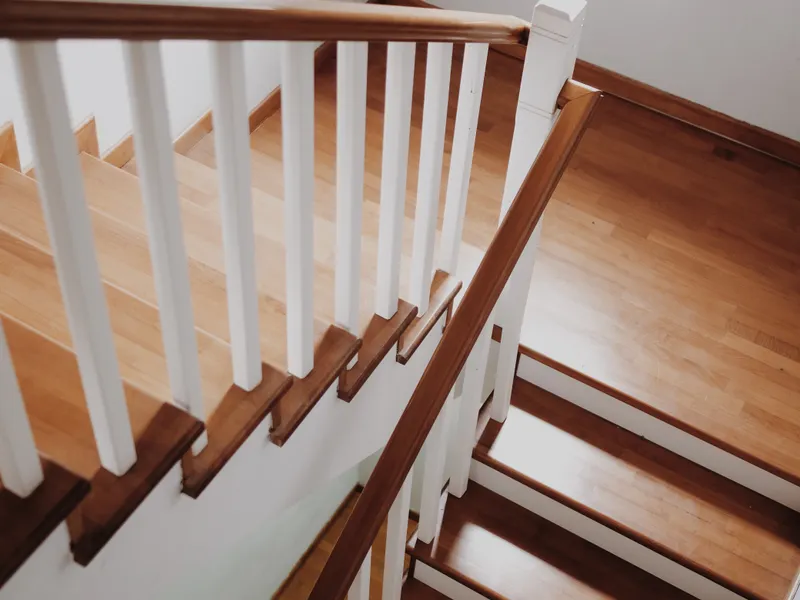
How do you tighten a loose newel post?
The newel is the heavy post at the bottom or the turn of the stair, and the whole railing depends on it. Oak railings from the 1960s to 1980s are common in Thornhill, and after decades of hands pulling on them the post fasteners have often worked loose.
Many posts are held by a bolt hidden behind a round wood plug near the base. The plug comes out, the nut is tightened or the bolt replaced, and a new plug goes in.
Where there is no bolt, or it has torn out its hole, long structural screws are driven at an angle through the base of the post into the stair framing, then plugged. Glue or caulk around the base does nothing.
If the post is tight and the floor under it moves, the problem is in the framing. We will tell you that instead of adding screws.
Can loose or broken balusters be replaced?
Yes. A baluster is held at the top in a groove or hole under the handrail and at the bottom on the tread. Loose ones are re-glued and pinned with a brad driven at an angle. Rattling tops often mean a missing fillet, the small filler strip between balusters in the handrail groove.
A broken baluster is replaced with a matching profile. Common oak patterns are still sold; an unusual one may need the closest match or a custom turning. New oak beside decades-old oak never matches straight away.
The handrail on the wall is pulling out
Look at what the brackets are screwed into. A wall rail whose brackets were set at even spacing often has one or two in hollow drywall, held by a plug.
The fix is to move those brackets onto studs, usually a few inches along, and patch the old holes. A handrail has to take a person's full weight in a stumble, so wall anchors are not an acceptable substitute here.
When does stair work need a permit?
Tightening, re-gluing and replacing a part with the same part is repair.
Rebuilding a staircase, replacing stringers, changing the rise or layout, or altering the guard along an open side is different. The building code sets guard height, the size of openings and the load a guard must resist.
For anything structural, or any change to a guard, check with your city's building department before work starts: the City of Vaughan if you are west of Yonge Street, the City of Markham if you are east. We flag these jobs and do not take them on as simple repairs.
Stair & Railing Repair questions
Will the repair show afterwards?
Plugs are cut from oak with the grain lined up, so they are hard to spot from standing height. Up close on a stained stair, a plug can be seen.
Can a cracked tread be saved?
A crack running with the grain that has not broken through can be glued, clamped and backed with a plywood cleat underneath. A split nosing means a new tread, and on an open side the balusters come out to do it.
Can you add a handrail where there isn't one?
Yes. Basement stairs in older houses often have none. The rail goes on brackets fixed to studs, at the height the building code calls for.
Is a wobbly railing urgent?
Treat it that way. A post that moves under hand pressure will move further under a falling person, so keep weight off it until it is fixed.
Can you close up wide gaps between spindles for a toddler?
That changes the guard, so it falls under the code rules above. Check with your city first.
Show us the step or the post that moves
Send a photo of the stair and a line on what moves or squeaks through the quote form. Say whether the underside of the stair can be reached from a basement or closet.